


120# Trading with Market Structure MT5
Submit by Janus Trader 2025
Trading with Market Structure MT5 strategy leverages breaks of structure (BOS) and change of character (CHOCH) along with directional arrow signals to identify optimal entry points. An optional trend filter can be used to improve signal reliability.
Setup
-
Time Frame: H1 (Swing Trading) or M15 (Intraday)
-
Platform: MetaTrader 5 (MT5)
-
Indicators:
-
Market Structure Indicator (BOS, CHOCH)
-
Arrow Indicator (Directional signals)
-
Trend Filter RSI (Optional, for confirmation)
-
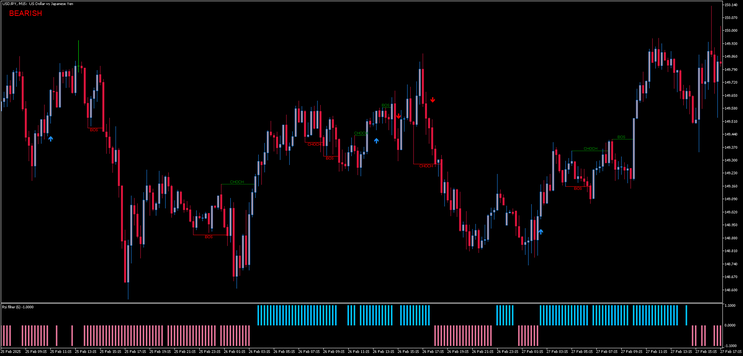
Entry Rules
Long (Buy) Setup
-
Structure Shift
-
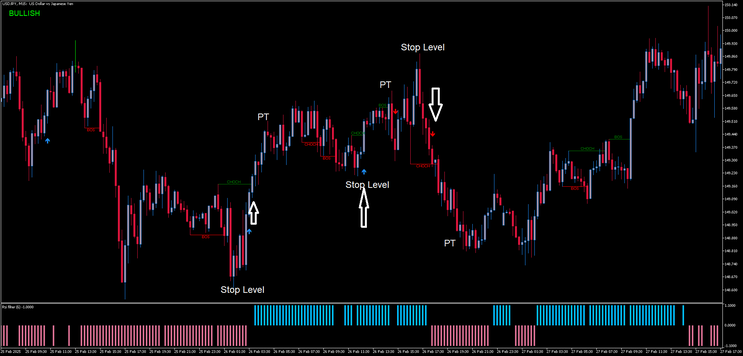
A bullish CHOCH (green) or a BOS in an uptrend occurs.
-
-
Arrow Confirmation
-
A blue upward arrow appears (it can appear before or after the structure shift).
-
-
Trend Filter Confirmation (Optional)
-
The trend filter is blue (bullish).
-
-
Entry
-
Enter at the close of the confirmation candle.
-
-
Stop-Loss
-
Below the recent low.
-
-
Take-Profit
-
Between 1:1 and 1:1.3, depending on market volatility.
-
Short (Sell) Setup
-
Structure Shift
-
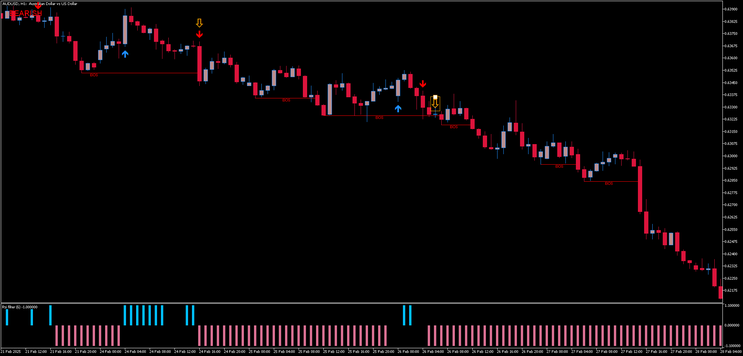
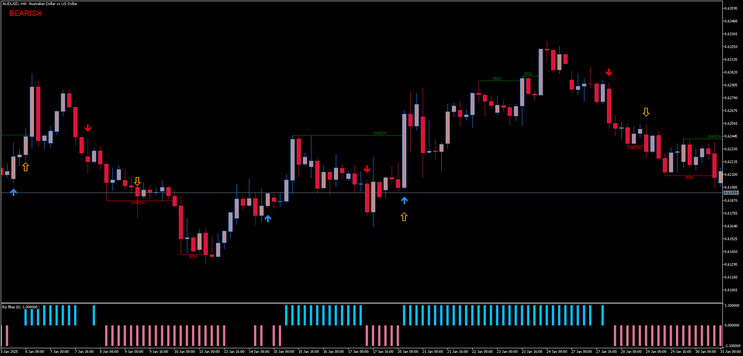
A bearish CHOCH (red) or a BOS in a downtrend occurs.
-
-
Arrow Confirmation
-
A red downward arrow appears (it can appear before or after the structure shift).
-
-
Trend Filter Confirmation (Optional)
-
The trend filter is red (bearish).
-
-
Entry
-
Enter at the close of the confirmation candle.
-
-
Stop-Loss
-
Above the recent high.
-
-
Take-Profit
-
Between 1:1 and 1:1.3, depending on market volatility.
-
Exit Strategy
-
Aggressive Option: Exit when the opposite CHOCH appears.
-
Conservative Option: Exit at the next structure break in the opposite direction.
Conclusion
This strategy combines market structure shifts + directional signals, ensuring a high probability of success. The 1:1 to 1:1.3 TP range provides a balanced risk-reward approach, adaptable to market conditions.


Rudd (Monday, 13 April 2026 19:06)
The “Trading with Market Structure” approach presented in this strategy reflects a price-action-centric methodology, grounded in the identification of structural shifts in market behavior rather than reliance on lagging indicators. This places it within the broader category of discretionary trend-following and reversal frameworks, often associated with institutional trading logic (e.g., Smart Money Concepts, Wyckoff principles).
1. Core Concept: Market Structure as a Leading Signal
At its foundation, the strategy emphasizes the interpretation of market structure through swing highs and swing lows, which is a robust and time-tested approach. The identification of:
Higher Highs (HH) and Higher Lows (HL) → bullish structure
Lower Highs (LH) and Lower Lows (LL) → bearish structure
provides a contextual framework for directional bias.
What is particularly valuable here is the focus on Break of Structure (BOS) and potentially Change of Character (CHOCH) events. These structural shifts are often more reliable than indicator crossovers because they reflect actual order flow imbalances rather than derived signals.
However, one limitation is that structure interpretation can be subjective, especially in lower timeframes where noise increases. Without strict rules for defining valid swings (e.g., fractal-based or ATR-filtered pivots), two traders may interpret the same chart differently.
2. Entry Logic and Timing
The strategy appears to rely on entering trades after confirmation of a structural break, often combined with:
Pullbacks to previous structure zones (support/resistance flips)
Possible confluence with supply/demand or imbalance areas
This aligns with a continuation-based entry model, which is statistically more favorable than anticipating reversals prematurely.
From a technical standpoint:
Entering after BOS reduces false signals but introduces latency, meaning part of the move is already consumed.
Waiting for a pullback improves risk/reward but introduces the risk of missed trades in strong impulsive markets.
An improvement would be to define:
A precise entry trigger (e.g., engulfing candle, liquidity sweep, or rejection wick)
A minimum retracement threshold (e.g., Fibonacci 38.2–61.8 or structure midpoint