


24# A Deep Dive Into the Sniper Confluence Entry/Exit Indicator: A High‑Precision Tool for Modern Traders
Maximo Trader 2026
In the vast ocean of TradingView indicators, it’s rare to find something that genuinely stands out — not because it promises miracles, but because it is structurally well‑designed, technically coherent, and operationally useful. Recently, I came across an open‑source script that deserves exactly this kind of spotlight: Sniper Confluence Entry/Exit, an enhanced evolution of the classic EMA crossover system, rebuilt with a sophisticated seven‑factor confluence engine. This article introduces the indicator, explains how it works, and outlines why it may become a valuable addition to your trading toolkit.
What Makes This Indicator Different
Most crossover‑based systems suffer from the same weakness: they fire signals too early, too often, or without enough contextual confirmation. This script solves that problem by adding a multi‑layered confluence filter that validates every signal before it appears on the chart. Instead of relying solely on a fast/slow EMA cross, the indicator evaluates seven independent technical factors — including VWAP, RSI, MACD, EMA alignment, ADX and DI structure, volume behavior, and a secondary timeframe RSI — and assigns a score to each bar. Only when the score meets your chosen threshold does the signal appear. This transforms a simple crossover system into a probability‑weighted entry engine.

How the Indicator Works
The foundation of the script is a classic EMA crossover, where a fast EMA crossing above a slow EMA suggests a potential long, and the opposite suggests a potential short. However, this crossover alone is never enough to trigger an entry. Each bar is evaluated across the seven confluence dimensions mentioned above, and each confirming factor adds one point to the score. A signal appears only when the score reaches or exceeds the minimum threshold, which by default is set to four out of seven. This dramatically reduces noise and filters out low‑quality setups.
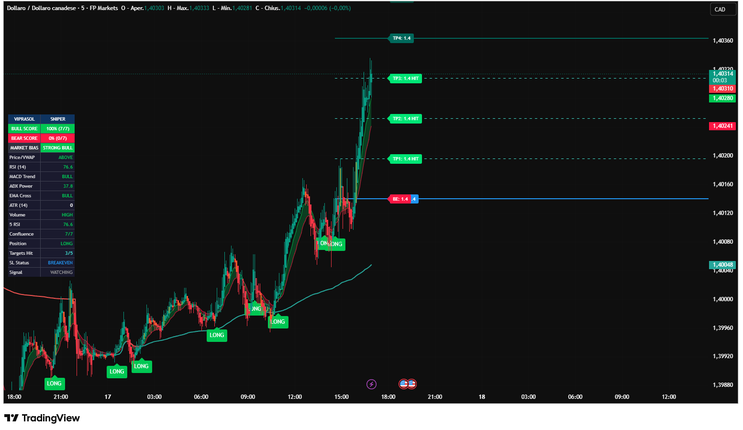
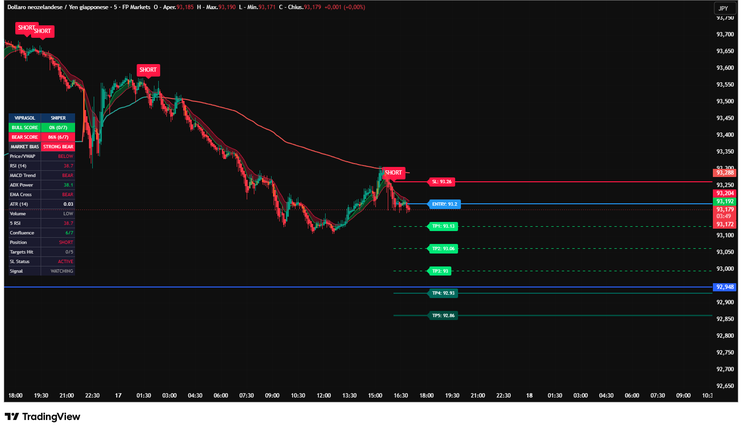
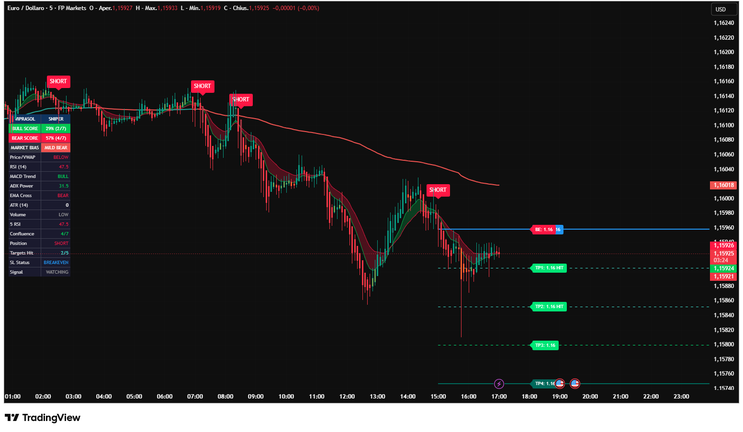
To avoid premature entries caused by intra‑bar volatility, the indicator allows you to require confirmation only at candle close, a crucial feature for fast markets. It also includes ATR‑based risk management, automatically plotting a stop‑loss level and up to five take‑profit levels, with an optional breakeven shift once the first target is hit. Pullbacks to the fast EMA after a signal are highlighted as retest candles, offering potential add‑on or re‑entry opportunities. A clean dashboard displays real‑time confluence scores, position status, target progression, and stop‑loss conditions, while multiple alert types allow automated notifications for entries and bias shifts.
Who This Indicator Is For
The tool is versatile enough to support scalpers working on one‑ to five‑minute charts, intraday traders operating between fifteen minutes and one hour, and swing traders using four‑hour or daily timeframes. Because the confluence threshold is adjustable, the indicator can be tuned for higher frequency or higher precision depending on the trader’s style. As a general guideline, scalpers may prefer fast EMAs such as 5 and 13 with a higher confluence requirement, intraday traders often work well with 9 and 21 EMAs and a moderate threshold, while swing traders typically combine the same EMAs with a wider ATR multiplier.

Strengths of the Indicator
The indicator stands out for the quality of its signals, which are strengthened by the multi‑factor confirmation process. Its visual structure is clear, with entry, stop‑loss, and take‑profit levels displayed directly on the chart. Risk management is flexible thanks to the breakeven and multi‑target options. The script works across all markets, including crypto, forex, indices, and stocks, and its open‑source nature ensures transparency and the possibility of customization.
Note: To have the photo configuration go to settings/style/ and check the buy or sell in relation to the VWap trend
Limitations to Consider
No indicator is perfect, and this one is honest about its boundaries. EMA crossovers remain lagging by nature, and consolidation phases may still produce whipsaws. The secondary timeframe RSI can repaint on the current bar, and the plotted take‑profit and stop‑loss levels are visual only, meaning they do not execute trades automatically. As always, market context and proper risk management remain more important than any algorithm.
Why I Decided to Feature It
What impressed me most is not the complexity, but the engineering discipline behind it. The author took a simple, widely used concept and elevated it with structure, logic, and transparency — something increasingly rare in the indicator ecosystem. For traders who appreciate clean, rules‑based setups with built‑in risk management, this script is absolutely worth exploring.
Final Thoughts
The Sniper Confluence Entry/Exit indicator is a strong example of what open‑source trading tools should be: transparent, functional, and thoughtfully designed. If you’re looking for a crossover system that avoids the usual pitfalls and provides high‑probability entries backed by real confluence, this is one of the best implementations currently available on TradingView.

24# The Fader Trading System
This is an intraday technique and write by Kathty Lien.
The fader strategy is
a variation of the waiting for the real deal strategy. It uses the daily charts
to identify the range-bound environment and the hourly charts to pinpoint
entry levels.
Long
1. Locate a currency pair whose 14-period ADX is less than 35. Ideally the ADX should also be trending downward, indicating that the trend is weakening further.
2. Wait for the market to break below the previous day’s low by at least 15 pips.
3. Place an entry order to buy 15 pips above the previous day’s high.
4. After getting filled, place your initial stop no more than 30 pips away.
5. Take profit on the position when prices increase by double your risk,
or 60 pips.
Short
1. Locate a currency pair whose 14-period ADX is less than 35. Ideally
the ADX should also be trending downward, indicating that the trend
is weakening further.
2. Look for a move above the previous day’s high by at least 15 pips.
3. Place an entry order to sell 15 pips below the previous day’s low.
4. Once filled, place the initial protective stop no more than 30 pips above
your entry.
5. Take profits on the position when it runs 60 pips in your favor.
Further Optimization
The false breakout strategy works best when there are no significant economic
data scheduled for release that could trigger sharp unexpected
movements. For example, prices often consolidate ahead of the U.S.
nonfarm payrolls release. Generally speaking, they are consolidating for
a reason and that reason is because the market is undecided and is either
positioned already or wants to wait to react following that release. Either
way, there is a higher likelihood that any breakout on the back of the release
would be a real one and not one that you want to fade. This strategy
works best with currency pairs that are less volatile and have narrower
trading ranges.
Examples
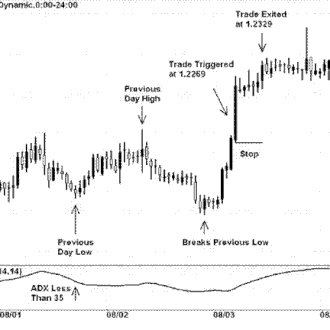
Figure is an hourly chart of the EUR/USD. Applying the rules just
given, we see that the 14-period ADX dips below 35, at which point we
begin looking for prices to break below the previous day’s low of 1.2166
by 15 pips. Once that occurs, we look for a break back above the previous
day’s high of 1.2254 by 15 pips, at which point we enter into position at
1.2269. The stop is placed 30 pips below the entry price at 1.2239, with the
limit exit order placed 60 pips above the entry at 1.2329. The exit order gets
triggered a few hours later for a total profit of 60 pips with a risk of 30 pips.
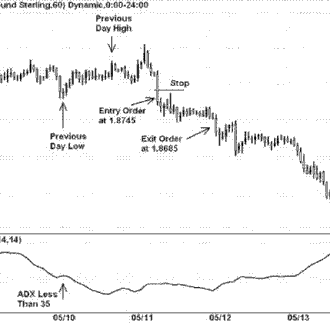
Figure 9.18 is an example of the fader trading strategy on the short
side. Applying the rules to the hourly chart of the GBP/USD, we see that the
14-period ADX dips below 35, at which point we begin to look for prices to
break 15 pips above the previous day’s high of 1.8865 or below the previous
day’s low of 1.8760. The break above occurs first, at which time we look for
prices to reverse and break back below the previous day’s low. A few hours
later, the break occurs and we sell 15 pips below the previous day’s low at
1.8745. We then place our stop 30 pips away at 1.8775 with a take profit
order 60 pips lower at 1.8685. The limit exit order gets triggered, and, as
indicated on the chart, the trade was profitable.
This Strategy Write by kathy
Lien “Day Tading and Swing Trading the
Currency Market,130-132.)
23# Waiting for Real Deal - Forex Strategies - Forex Resources ...
124# Braydensgrail - Forex Strategies - Forex Resources - Forex ...
22# Fading The Double Zero - Forex Strategies - Forex Resources
13# Donchian Channels - Forex Strategies - Forex Resources ...
Trend following Forex Strategies
133# Moving Average Trios - Forex Strategies - Forex Resources ...
89# Cowabunga - Forex Strategies - Forex Resources - Forex ...
99# Vidya - Forex Strategies - Forex Resources - Forex Trading-
49# On Trend - Forex Strategies - Forex Resources - Forex Trading
107# Trend or Range - Forex Strategies - Forex Resources - Forex
14#DOSR - Forex Strategies - Forex Resources - Forex Trading-
71# 3 Duck's - Forex Strategies - Forex Resources - Forex Trading ...

Luis Ronald Huaygua Cori (Thursday, 02 July 2026 05:36)
obrigado