


2# A Complete Multi-Timeframe Grid Trading Framework for Indices and Forex
Joy22 2026
Grid trading is often dismissed as a dangerous or simplistic strategy; in reality, when engineered with volatility-based spacing, multi-timeframe filters, and controlled exposure, a grid becomes a robust, predictable, and highly modular trading system.
This article presents a complete grid-trading framework designed for US500; NZDUSD; EURCHF; EURGBP; AUDCAD.
The system is built on the following core elements: ATR-based spacing; light position-size progression; daily timeframe trend filters; hedge logic for trend breakouts; clear exit conditions.
Core Principles
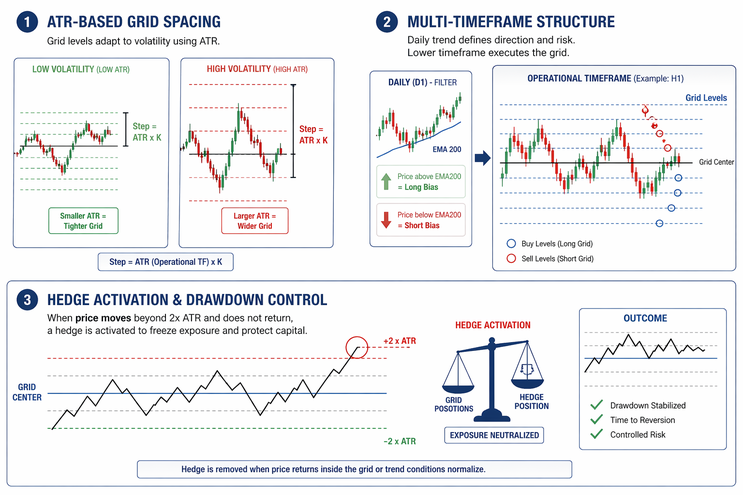
The operational timeframe defines the structure of the system; it determines ATR calculation, grid spacing, number of levels, and execution frequency.
The daily timeframe (D1) acts as a higher-level control layer; it functions as a trend filter, a risk filter, and a dominance selector for trend-adaptive grids; it is not used to calculate spacing.
Grid spacing is volatility-based; the step is defined as ATR of the operational timeframe multiplied by a coefficient K; this allows the grid to expand or contract dynamically depending on market conditions.
Position sizing follows a light progression model; 1.0; 1.1; 1.2; 1.3; this avoids aggressive martingale exposure while maintaining controlled scaling.
Each grid operates with four independent exit conditions; basket take-profit; reversion to the grid center; ATR compression; hedge exit.
Hedge logic is activated when price moves beyond approximately two times the ATR without reverting; in this case, a hedge position is opened to freeze drawdown, stabilize exposure, and prevent uncontrolled losses.
The Five Grids
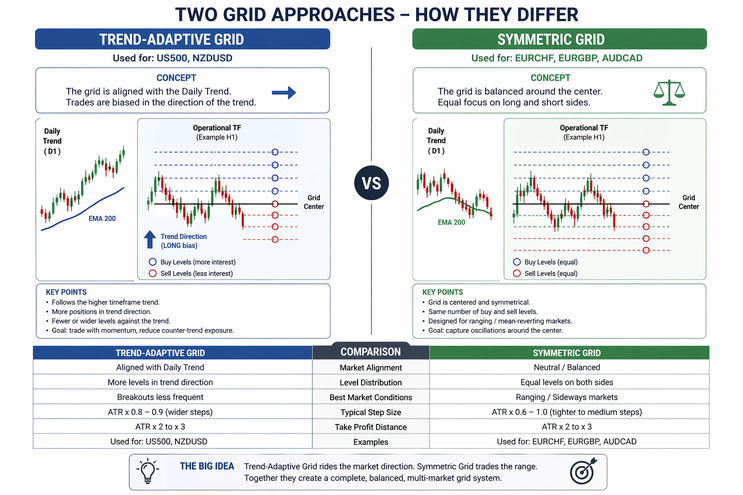
US500 uses a trend-adaptive grid on H1 with D1 confirmation; step is ATR multiplied by 0.8, typically between 12 and 20 points; six levels per side are used; the daily filter is based on EMA200 trend direction; exits include ATR multiplied by 2 take-profit, reversion, compression, and hedge.
NZDUSD uses a trend-adaptive light grid on H4 with D1 confirmation; step is ATR multiplied by 0.9, typically between 27 and 36 pips; eight levels per side are used; the daily filter is based on EMA50 and EMA200 alignment; exits include ATR multiplied by 3 take-profit, reversion, compression, and hedge.
EURCHF uses a symmetric grid on H1 with D1 filtering; step is ATR multiplied by 0.6, typically between 6 and 9 pips; ten levels per side are used; the daily filter reduces levels during strong trends; exits include ATR multiplied by 2.5 take-profit, reversion, compression, and occasional hedge activation.
EURGBP uses a symmetric grid on M15 or H1 with D1 filtering; step on M15 is approximately 3 to 4 pips, while on H1 it is 7 to 10 pips; twelve levels per side are used; the daily filter adjusts compression and expansion; exits include ATR multiplied by 2 take-profit, reversion, compression, and hedge activation during high-impact news.
AUDCAD uses a symmetric grid on H4 with D1 filtering; step is ATR multiplied by 1, typically between 25 and 35 pips; eight levels per side are used; the daily filter reduces levels during strong trends; exits include ATR multiplied by 3 take-profit, reversion, compression, and hedge.
Why This Framework Works
The framework adapts to volatility; it avoids martingale blow-ups; it respects higher-timeframe structure; it integrates a hedge mechanism; it remains modular and applicable across multiple assets; it maintains stability across different market regimes.
This is not a “set and pray” grid; it is a structured and engineered system designed for long-term consistency.
Note:This topic requires basic knowledge of Hedging.
This article outlines the structural layer of the framework; a more advanced version, including execution logic, risk calibration, and full system design, is available in the premium edition; contact: [email protected]
2# Minor Reaction/Trend Resumption Trading System
Range Breakout Trading System
Submit Forexstrategiesresources
The Minor Reaction/Trend Resumption System (MR/TR) was designed by Jack Schwager and published in his book Schwager on Futures: Technical Analysis (John Wiley & Sons, 1996).
Schwager called this system "Reversal of Minor Reaction".
MR/TR uses a price channel to determine the trend. If the most recent breakout of the channel was to the upside, the trend is bullish; if the most recent breakout was to the downside, the trend is bearish.
Setup
a) Calculate a 40-bar price channel of highs and lows.
Long Entries
a) Determine the trend by locating the most recent breakout above or below the price channel. If the breakout was above the channel, begin monitoring for downward reaction bars. When the reaction count reaches four, begin monitoring for bullish thrust bars.
When the thrust count reaches two, the buy setup is complete.
b) Buy at the high of the setup bar plus one point. The setup is cancelled if the entry is not triggered within four bars.
Short Entries
a) Determine the trend by locating the most recent breakout above or below the price channel. If the breakout was below the channel, begin monitoring for upward reaction bars. When the reaction count reaches four, begin monitoring for bearish thrust bars. When the thrust count reaches two, the sell setup is complete.
b) Sell short at the low of the setup bar minus one point. The setup is cancelled if the entry is not triggered within four bars.
Exit Orders
a) Place a protective stop 4 pips below the low of the reaction for a long position and 4 pips above the high of the reaction for a short position.
b) We'll also enable a $ risk trailing stop.
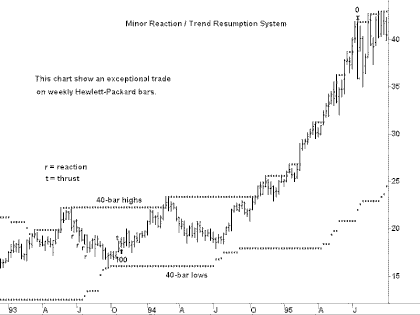
In the picture Minor Reaction/Trend Resumption forex system in action.
-
#1
fine
