


273# Turtle Soup Liquidity Reversal TradingView Indicator
Dimitri 2025 author Flux Chart
The Turtle Soup Liquidity Reversal Strategy is a smart-money model
built around liquidity manipulation concepts popularized by ICT.
This approach aims to catch false breakouts at key market levels—entering when price sweeps liquidity
and then sharply reverses.
This script automates the entire process, from identifying liquidity pools to signaling entries, exits, and visually confirming market structure shifts on your TradingView chart.
Core Concept
Markets often lure traders into breakout traps.
A liquidity sweep occurs when price briefly pushes beyond a major swing high or low—triggering stop-losses and breakout orders—before reversing.
This strategy seeks to:
-
Identify high-probability liquidity zones.
Wait for a fake breakout (liquidity sweep).
Confirm a reversal via structure shift.
Enter the market in the opposite direction of the sweep.
Use ATR-based stops and targets for adaptive risk control.
In simple terms:
When the market hunts liquidity, we trade the
reversal.
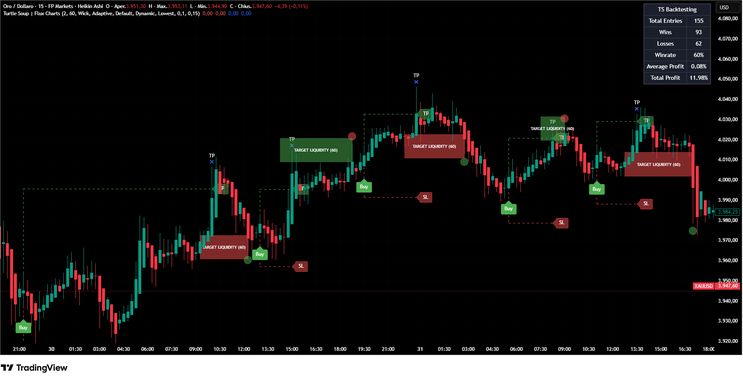
Step-by-Step Logic
1️Identify Higher-Timeframe Liquidity
The indicator maps liquidity pools formed by major swing highs and lows on a timeframe above the current chart (e.g., 1H levels on a 5M chart).
These levels often act as bull and bear traps.
2️Analyze Current-Timeframe Structure
Local market direction is mapped using swing points to track:
-
Minor trends
Market flow shifts
Key micro-structure levels
This helps detect when the market transitions from breakout mode to reversal mode.
3️Detect a Liquidity Sweep
When price wicks or briefly closes above/below a liquidity pool but then rejects, a liquidity grab is registered.
4️Directional Bias
-
Sweep above = Sell setup (short)
Sweep below = Buy setup (long)
This aligns with the idea:
When bulls get trapped → we sell; when bears get trapped → we buy.
5️Market-Structure Shift Confirmation
After the sweep, price must break micro-structure in the opposite direction, confirming smart-money flow toward the reversal.
6ATR-Based SL & TP
Stops and targets use ATR to adapt position size to market volatility, maintaining a minimum 1:1 reward-to-risk ratio or higher depending on settings.
Unique Features
-
Full Turtle Soup execution model.
Higher TF liquidity mapping.
Adaptive entry logic that learns from previous signals.
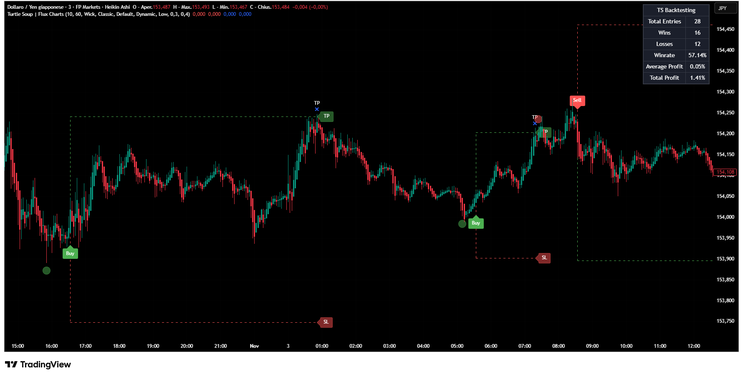
Visual trading steps on chart.
Automatic stop-loss & take-profit placement.
Backtesting dashboard.
Event alerts for entry, exit, SL, and TP.
This system simplifies a professional-grade strategy, allowing traders to visually follow each stage of execution.
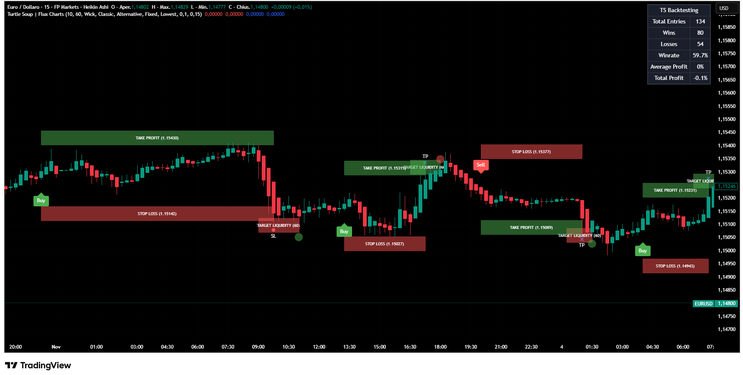
General Settings
The strategy includes several core configuration options to tailor execution and market reading:
-
Swing Sensitivity determines how the script identifies swing highs and lows, which are used to detect structural breaks. Increasing this value means only stronger pivots are considered, filtering out noise.
Higher-Timeframe Selection allows you to choose the timeframe where liquidity levels will be tracked. This must be greater than the chart’s current timeframe, as the system compares lower-timeframe price action against higher-timeframe liquidity.
Breakout Confirmation Method gives you the option to validate liquidity sweeps using either candle wicks or candle closes.
-
Wick confirmation recognizes even brief spikes beyond a level.
Close confirmation is stricter, requiring a full candle close above or below the liquidity line.
Entry Mode lets you choose between the standard execution logic or an Adaptive mode.
The Adaptive option evaluates previous trades and performance patterns. Based on this feedback, it may maintain the original bias or invert entries when necessary, seeking to improve alignment with current market behavior. -
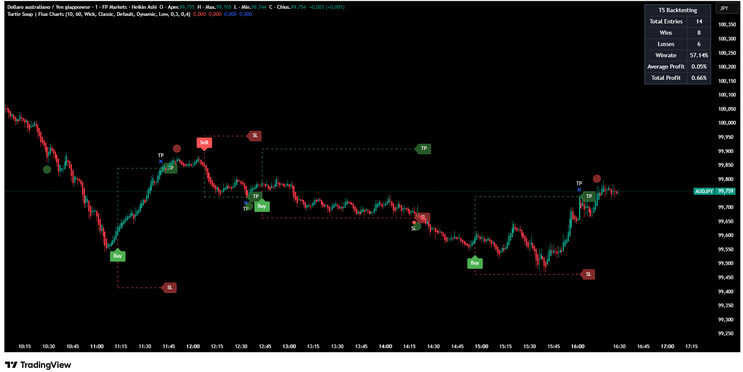
Risk & Reward Controls
The strategy uses dynamic risk tools to match market conditions:
-
Take-Profit / Stop-Loss Mode can be fixed or algorithm-generated. In fixed mode, the ratios remain constant. In algorithmic mode, levels adjust automatically based on conditions detected by the system.
ATR-Based Risk Factor determines the stop-loss and take-profit distance relative to market volatility.
A higher ATR multiplier typically strengthens win-rate stability but increases the potential size of losses when trades fail.
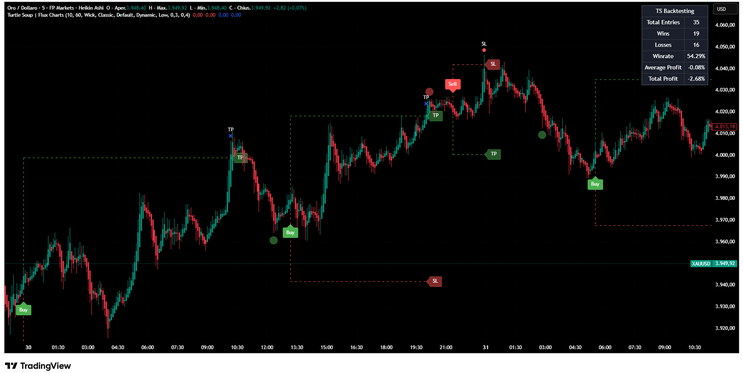

273# FX11 Trading System
Submit By Joker 23/12/2012
See manual
This is the first step you take when starting to look into trading. You know that its a
good way of making money because you've heard so many things about it and heard
of so many millionaires. Unfortunately, just like when you first desire to drive a car
you think it will be easy - after all, how hard can it be? Price either moves up or
down - what's the big secret to that then – let’s get cracking!
Unfortunately, just as when you first take your place in front of a steering wheel you
find very quickly that you haven't got the first clue about what you're trying to do.
You take lots of trades and lots of risks. When you enter a trade it turns against you
so you reverse and it turns again and again, and again.
You may have initial success, and thats even worse - cos it tells your brain that this
really is simple and you start to risk more money.
You try to turn around your losses by doubling up every time you trade. Sometimes
you'll get away with it but more often than not you will come away scathed and
bruised You are totally oblivious to your incompetence at trading.
This step can last for a week or two of trading but the market is usually swift and
you move on the next stage....see manual
Share your opinion, can help everyone to understand the forex strategy.

